


- PV park with impressive size of 125 MWp
- Around 30 per cent of the solar park is owned by citizens through an energy cooperative
- Objectives: Generation of solar power, provision of heat for households and businesses on site and charging stations for electric vehicles
- Measures to contribute to independence from fossil fuels


Bundorf is one of the regions with particularly low rainfall and long dry periods in Bavaria. This poses a growing challenge for the agricultural utilisation of arable land. The region is therefore categorised as one of the ‘disadvantaged areas’. This means that agricultural land can only achieve low yields or is difficult to utilise due to factors such as soil quality or topographical conditions (e.g. slopes). In Germany, this applies to around 50 per cent of agricultural land. In accordance with the state opening clause of the Renewable Energy Sources Act (EEG), the federal states can decide whether to authorise the construction of PV parks in these areas. In 2020, the idea for one of the largest ground-mounted solar parks to date was born in Bundorf. Construction began in October 2022 on a total area of around 125 hectares, including a transformer station. However, with a total output of around 125 megawatts, the PV park offers more than just the generation of solar power.
It is a showcase project for a comprehensive energy transition:
- Citizen participation concept
- Sustainable district heating network
- Charging infrastructure for electromobility
- Measures to promote biodiversity
The cooperative collaboration between all those involved is particularly commendable. From the mayor and municipal representatives to the project developers, operators, landowners and the residents of Bundorf - everyone pulled together from the very beginning. It took less than two years from the first project outline to realisation. All the necessary authorisations were granted within a year and a total of around 85 million euros was invested. In future, around a third of the park will be operated by the citizens‘ energy cooperative EGIS eG as a citizens’ solar plant, including the sustainable district heating network.
In purely mathematical terms, the approximately 125-megawatt project could generate enough electricity for around 37,500 households.
E-charging infrastructure - environmentally friendly driving
In Bundorf, the promotion of electromobility is also an integral part of the concept. A total of six charging stations, each with two charging points, are available to provide electric vehicles with environmentally friendly electricity.
Bundorf district heating network - Turning green electricity into heat
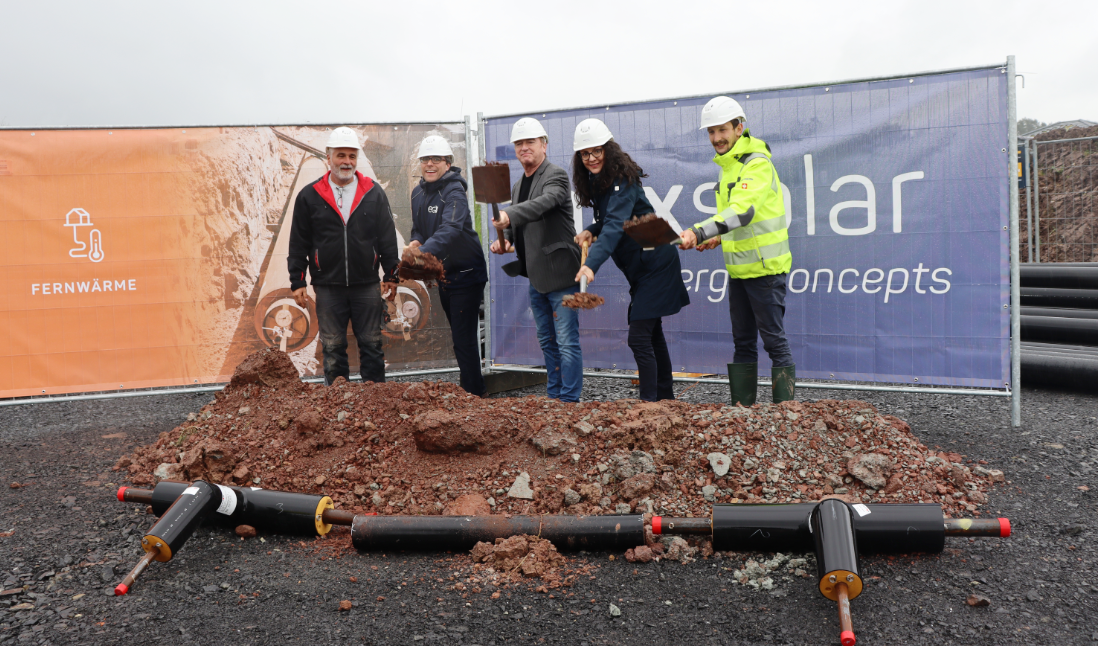
In addition to the solar park, a district heating network was built to supply the municipal buildings and residents with heat.
- Conducts heat to the buildings as required (including public buildings such as the community centre and kindergarten)
- Large hot water storage tank (buffer tank) ensures sufficient heat during the winter months and low solar radiation
- 200-kilowatt wood chip boiler for additional security in winter months
As the general contractor, we were responsible for the planning and realisation, while Fernwärme Bundorf GmbH & Co. KG acts as the operator of the district heating network.


- The Bundorf PV park is an outstanding example of a citizen-centred energy transition.
- It illustrates the added value of energy transition projects for structurally weak regions, which can benefit from regional value creation and thus become more attractive.
- Such projects are urgently needed to promote climate protection, biodiversity and rural development.

MaxSolar as an Independent Power Producer (IPP)
70% of the ground-mounted solar system is operated by MaxSolar as an Independent Power Producer (IPP). The electricity generated is marketed via a so-called Power Purchase Agreement (PPA). This type of marketing of renewable energy is now widespread in Germany. Electricity supply contracts are concluded directly with an electricity consumer over a fixed period of time.
EGIS eG as an energy cooperative
The community solar park (30% of the total area) and the district heating network are operated by EGIS eG. In addition, citizens, local authorities, associations, foundations and companies have the opportunity to acquire shares in the cooperative. A co-operative share has a value of 150 euros plus a surcharge of 5 euros. The purchase of co-operative shares is currently limited to 4,300 shares per member, which corresponds to a total amount of 645,000 euros.
However, membership of the energy cooperative is not limited to the PV project in Bundorf, but includes 20 energy transition projects throughout Germany. Members receive an annual dividend of currently 6 per cent.


The following measures are being implemented to promote biodiversity in Bundorf:
- Wide sunny strips between the rows of modules
- Development of species-rich and flower-rich grassland
- Planting of hedges, wooded islands and fruit trees
- Free passage for wild animals
The measures are described in more detail in the following section.
If the ground is exposed to sunlight by spacing the rows of modules sufficiently far apart, species-rich grassland can develop on the areas by sowing native seed mixtures with a high proportion of herbaceous species and appropriate care. Insects in particular benefit from the flower-rich meadows, which in turn are an important food source for breeding birds. Ground-nesting birds also benefit from the wide, sunny strips.
Planting islands with native shrubs, hedges and fruit trees create additional structures and habitats and further enhance the ecological value of the previously poorly structured agricultural areas. Woody areas provide birds, amphibians, insects and mammals with shelter, food and nesting opportunities. The woodland planting not only creates visually and structurally soft transitions, but also provides shade and thus cools the surroundings. This cooling effect can be measured up to 20 metres away from a two metre high hedge. Soil covered by shrubs, hedges and fruit trees promotes humus formation and groundwater recharge and thus protects against erosion.
To ensure that small and medium-sized mammals such as mice, hares and foxes have unhindered access to the PV park, all fences are at least 15 cm above the ground. Larger wild animals can pass through the site via a wildlife corridor.

Ornithological surveys are being carried out at the Bundorf solar park to monitor the skylark population. The most important results are
- 26 breeding territories were documented prior to the construction of the plant, with a density of 0.25 territories per hectare on arable land.
- In 2023, 65 breeding territories were counted, which corresponds to a density of 0.6 breeding pairs per hectare - more than twice as high as before construction.
- In 2024, monitoring showed a further increase to 99 breeding territories and a density of 0.766 territories per hectare - more than three times the original value.
The reasons for the high population density are the increased raw soil content, the lack of pesticides, the absence of regular cultivation and an improved food supply.
The example of Bundorf shows that photovoltaic systems and species protection can go hand in hand.
We have already received the following awards for our Bundorf flagship project:
TOP 100 Innovator
In 2024, MaxSolar was honoured with the Top 100 Award for the Bundorf sector coupling project. The project impressed the jury with its integration of different sectors: generation of green electricity from the ground-mounted system, emission-free district heating, successful biodiversity measures in the solar park and a local e-charging infrastructure. The project thus sets new standards for sustainable energy concepts in rural areas.
The smarter E AWARD - Outstanding Projects
Exceptional achievements and innovations are honoured in the "Outstanding Projects" category. Our Bundorf innovation project brought us victory and emphasises our innovative strength and our commitment to sustainable energy solutions.

